Florida Residential Address with Lease Agreement and Utility Bill
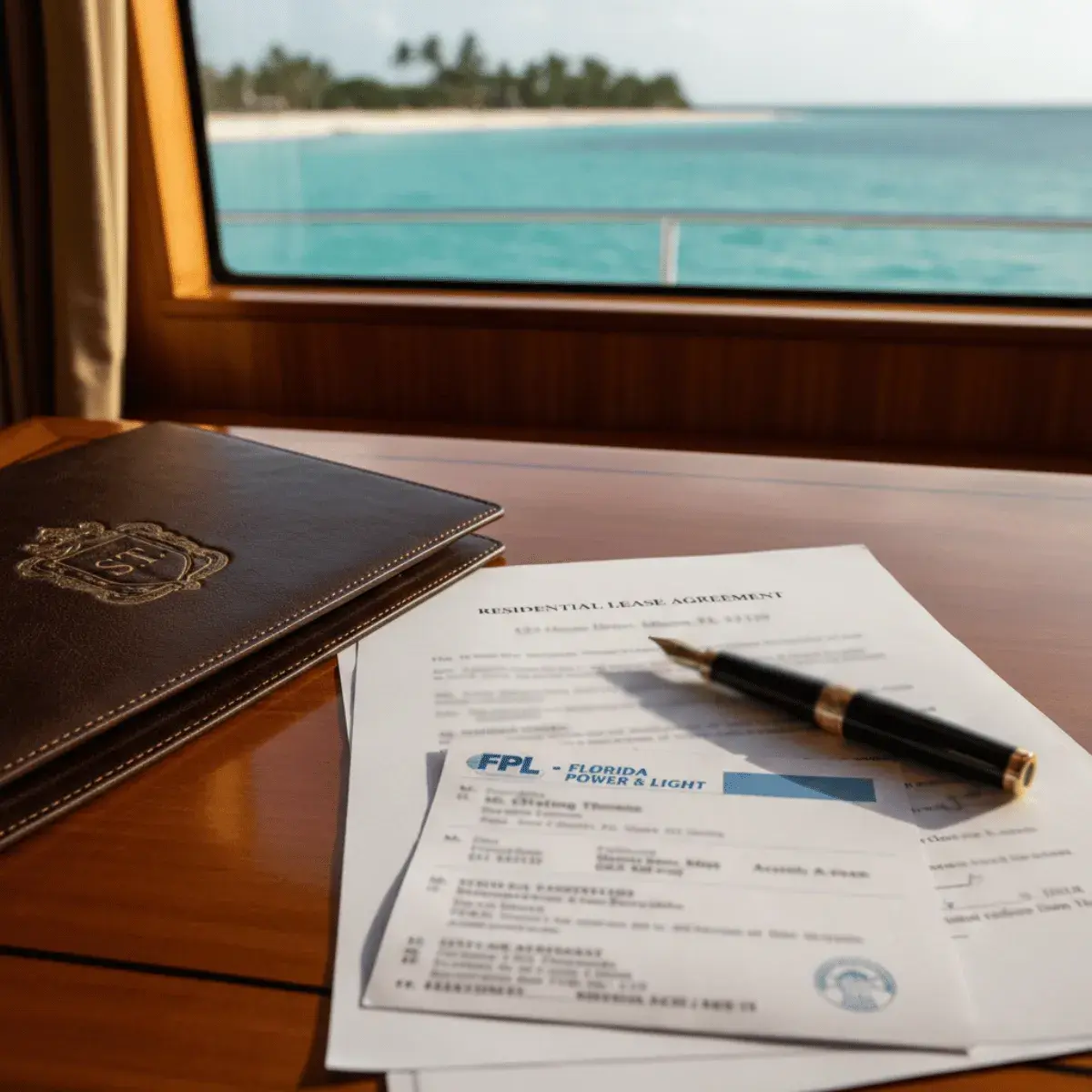
A residential-class florida residential address, with a real lease and utility in your name.
Premium pairs a residential-class Florida address with a real multi-year lease and a utility bill in your name. The same evidence package banks, brokerages, the DMV, and former-state auditors actually look for.
Potential Tax Savings*
Up to 14.8% of your income
Estimated. Actual savings vary.
What Makes Premium Different
Our standard plans provide a Florida residential address and virtual mailbox: everything you need to establish Florida as your domicile. Premium goes further with authentic lease and utility documentation for those who need it for banking or institutional verification.
Important: Premium documentation is limited and subject to availability. Premium is $250/mo billed annually ($3,000/year) and is set up after a call with our team. The lease agreement and utility bill are an optional $500 add-on.
Includes everything in Standard, plus:
- Residential lease agreement in your name
- Utility bill showing your Florida address
- Priority support throughout the process
Why Florida for Asset Protection
Florida offers some of the strongest asset protection laws in the country.
Address Documentation
A residential lease agreement and utility bill in your name. The same documentation traditional renters provide. Designed to support address verification needs. Individual institution policies vary.*
Homestead Protection
Florida's homestead exemption may protect your primary residence from certain creditors. Consult an attorney for specifics.*
No State Estate Tax
Florida has no state estate or inheritance tax. Potential savings compared to high-estate-tax states. Federal estate tax still applies.*
Tenancy by Entirety
Married couples' jointly-owned assets protected from individual creditors automatically.
Community Property Trust
Double step-up in basis at first spouse's death. Significant capital gains tax savings on appreciated assets.
Personalized Support
Dedicated support with secure document handling. We guide you through each step of the process.
How Premium Works
Step 1
Sign Up & Book a Consultation
Create your account and schedule a call to discuss your documentation needs and availability.
What you'll get: Access to our onboarding process and consultation scheduling.
Step 2
Complete Notarization & Onboarding
Remote notarization via Proof.com, then we begin preparing your documentation package.
What you'll get: Notarized 1583 form + active virtual mailbox with your Florida address.
Step 3
Receive Your Premium Documentation
Lease agreement and utility bill in your name, an optional $500 add-on (subject to availability).
What you'll get: Premium documentation package for address verification purposes.
Step 4
Establish Your Florida Residency
Use your documentation for driver's license, banking, and other residency requirements.
What you'll get: Ongoing mail management + organized documentation for your records.
Premium Documentation Package
Subject to availability. Optional $500 add-on to the Premium plan.
Residential Lease Agreement
A genuine Florida residential lease with your name, address, and lease terms
Utility Bill Statement
A utility statement showing your Florida address
Address Verification Letter
Official verification letter when institutions request additional proof
Declaration of Domicile Support
Guidance for filing your Declaration of Domicile with the county clerk
Designed to meet typical requirements of private banks, wealth managers, brokerage accounts, and real estate transactions. Individual institution acceptance may vary.
Trusted by professionals
Here’s what our clients are saying about Your Tax Base.
4.97 ★
Customer rating
0%
Florida state income tax
Florida Premium FAQ
Interested in Premium Documentation?
Start with a free account, then book a consultation to discuss availability and pricing.
*Documentation designed to meet typical KYC requirements. Individual financial institution policies vary and acceptance is not guaranteed. Asset protection, estate planning, and tax benefits require proper legal implementation. Florida homestead protection has specific requirements and exceptions. Changing domicile requires meeting state requirements. Your former state may challenge residency changes. This information is for educational purposes only and does not constitute tax, legal, or financial advice. Consult qualified attorneys and tax professionals for advice specific to your situation.
Why a Residential-Class Florida Address Beats a CMRA
Most virtual mailbox companies assign you a Commercial Mail Receiving Agency address. The USPS classifies these locations as CMRAs under Domestic Mail Manual section 508. That is a commercial category rather than a residential one, and banks, brokerages and the Florida DHSMV each set their own rules about which address types they will take. Commercial mail-receiving addresses are frequently excluded from those rules.
A residential-class address is the opposite. It resolves to a real housing unit, not a counter at a UPS Store, not a back room at a private mail shop, not a warehouse with mail slots. The unit you list is a place a person could plausibly sleep tonight, and the lease and utility tied to that unit are in your name. That is the distinction every downstream institution actually cares about.
The reason this matters comes down to who built the rules and what they were trying to prevent. USPS Form 1583 is the form a CMRA operator collects when they accept mail on your behalf. It exists so the Postal Inspection Service can trace fraud back to a real human. The form is fine. What is not fine is letting the CMRA address itself stand in for your home of record. Banks and brokerages are bound by federal Customer Identification Program rules, often called CIP and KYC, and most carved out CMRAs years ago because criminal cases kept tracing back to them. The forms you sign for a brokerage account, the W-9 you submit, the FATCA and CRS self-certifications, all ask for your residence address, not your mailing address.
State tax auditors run the same playbook from the other direction. The California Franchise Tax Board, in Publication 1031, treats a CMRA flag as evidence that a taxpayer never actually broke California domicile. New York auditors do the same with their statutory residency review. A residential-class address with a lease and a utility in your name is a stronger record than a commercial mailbox. Only tax authorities and courts decide where you are domiciled.
The DMV is the cleanest example. Florida Statutes section 322.031 and the DHSMV implementing rules require two proofs of residential address before a license is issued. A CMRA assignment letter is not on the accepted-document list. A residential lease and a utility bill in your name are. The form has been the same for years and the examiners are trained to spot the difference.
That is the gap our Premium tier is built for. You get a residential-class Florida address at a real housing unit, paired with a lease and a utility you can hand to any institution that asks. For background on why these rules exist and who enforces them, see our Florida residency requirements guide and the document checklist for new Florida residents.
What Florida Premium Includes
Florida Premium is a documentation package, not a mailbox. The components are picked specifically because they map onto what banks, brokerages, the DMV, and state auditors actually ask for. Standard plans give you a Florida address with mail handling. Premium adds the paper trail.
Signed multi-year residential lease. You receive a real Florida residential lease with your legal name as tenant, the property address, the start and end dates, the monthly rent, and the landlord signature. The lease is not a one-page mailbox agreement and it is not a month-to-month placeholder. Multi-year terms hold up better in audit because they show continuity, which is one of the soft factors a state revenue department weighs when deciding whether you actually moved or just papered the move.
Utility bill in your name. You receive a recurring utility statement at the property, addressed to you. Banks asking for two proofs of address will typically take a lease and a utility together. The utility is the second piece almost every list requires.
Mail handling that satisfies USPS Form 1583. Even though the address is residential-class, the mail handling itself uses a notarized 1583 so the chain of custody is clean. You get scanning, forwarding, and shredding from the dashboard, with the same digital mailroom workflow as the standard tiers. See how the virtual mailbox works for the full feature list.
Declaration of Domicile filing assistance. Florida Statutes section 222.17 lets a new resident file a sworn Declaration of Domicile with the clerk of the county where they reside. Recording that document is one of the cleanest single artifacts a former-state auditor will see. We prepare the form, walk you through the notarization, and confirm the recording.
Premium vs CMRA vs PO Box vs Friend's Address
How each address type performs against the seven verifications that matter for establishing Florida domicile.
| Verification | YTB Premium | CMRA / UPS Store | PO Box | Friend's Address |
|---|---|---|---|---|
| Bank CIP / KYC | Commonly accepted | Often excluded | Rejected | Risky |
| Brokerage W-9 / CRS | Commonly accepted | Often rejected | Rejected | Risky |
| DMV residency proof | Commonly accepted | Not on list | Not on list | Possible with affidavit |
| FTB / NY auditor review | Defensible | Treated as paper | Treated as paper | Weak; depends on facts |
| IRS Form 1040 home address | Appropriate | Discouraged | Discouraged | Depends on facts |
| FBAR / FinCEN 114 | Appropriate | Discouraged | Not allowed for residence | Depends on facts |
| Employer payroll address | Commonly accepted | Often excluded | Rejected | Possible |
Bank CIP / KYC
- YTB Premium: Commonly accepted
- CMRA / UPS Store: Often excluded
- PO Box: Rejected
- Friend's Address: Risky
Brokerage W-9 / CRS
- YTB Premium: Commonly accepted
- CMRA / UPS Store: Often rejected
- PO Box: Rejected
- Friend's Address: Risky
DMV residency proof
- YTB Premium: Commonly accepted
- CMRA / UPS Store: Not on list
- PO Box: Not on list
- Friend's Address: Possible with affidavit
FTB / NY auditor review
- YTB Premium: Defensible
- CMRA / UPS Store: Treated as paper
- PO Box: Treated as paper
- Friend's Address: Weak; depends on facts
IRS Form 1040 home address
- YTB Premium: Appropriate
- CMRA / UPS Store: Discouraged
- PO Box: Discouraged
- Friend's Address: Depends on facts
FBAR / FinCEN 114
- YTB Premium: Appropriate
- CMRA / UPS Store: Discouraged
- PO Box: Not allowed for residence
- Friend's Address: Depends on facts
Employer payroll address
- YTB Premium: Commonly accepted
- CMRA / UPS Store: Often excluded
- PO Box: Rejected
- Friend's Address: Possible
Outcomes summarize the typical institutional position and are not guarantees. Each bank, brokerage or agency decides whether it accepts an address and may change its policies at any time. This is not legal or tax advice.
The Lease and Utility Evidence Pattern
State tax auditors do not look for one document. They look for a pattern. The question they ask, in plain English, is whether the taxpayer behaves like someone who actually lives in the new state. Florida domicile cases have been decided on the same handful of factors for decades, and the lease plus utility pattern hits more of them than any other single combination.
Start with the DMV. Florida Statutes section 322.031 requires a person who becomes a resident to obtain a Florida driver license within 30 days. The DHSMV residency-proof checklist asks for two documents from a long list, but in practice almost every applicant brings the same two, a lease and a utility bill. Those two documents alone are sufficient to clear the residency portion of the license application.
The same pattern carries through banking. A bank opening an account under Customer Identification Program rules collects a residence address and at least one verifying document. Most large banks accept either a lease or a utility, but when an account is flagged for review, the reviewer is happier seeing both. Brokerages are stricter. The W-9 form, the W-8BEN if applicable, and the FATCA and CRS self-certifications all reference the same address. If the address fails the residential-class test downstream, the account is paused, not closed, and the firm asks for additional proof. The lease and utility, dated, in your name, tied to the same Florida address, almost always resolves the request.
Where the lease and utility really earn their place is in former-state defense. California, New York, Illinois, Connecticut, Massachusetts, and a few others are aggressive about claiming taxpayers as continuing residents after a move. Their auditors look at twelve to fifteen factors, including where you keep your license, where you vote, where your doctors and dentists are, where you store your near-and-dear belongings, and where your home of record is. A multi-year lease at a Florida address tells the auditor that you intended to stay, not that you visited for a weekend. A utility statement with billing history shows continuity. Together they are the evidence a former-state auditor finds hardest to dismiss as paper.
The last piece is the county-clerk Declaration of Domicile under Florida Statutes section 222.17. It is a sworn statement, recorded in the public record, that you intend Florida to be your domicile. It is not required to establish residency, but recording one is one of the highest-leverage acts you can take in a contested domicile case. The recording date is the bookmark a tax court will use when asked when you became a Floridian. Pair it with a lease that predates your departure from the high-tax state, a utility that begins shortly after, and a federal Form 1040 filed at the Florida address, and you have the standard pattern that domicile attorneys advise their clients to build.
Federal address-of-record changes round it out. The IRS recognizes a change of address through Form 8822. Filing it after recording the Declaration of Domicile, and using the same address on your next Form 1040, is a quiet way to tell the federal government that your tax home moved. State auditors regularly subpoena IRS address records during audits, and a clean federal trail removes one more line of attack.
What Florida Residency Saves You Each Year
Estimate the state tax you stop paying once Florida is your domicile.
Live Savings Calculator
What does staying in your state actually cost?
Current state tax
$9,705
Florida tax
$0
Net first-year savings
$9,045
That's ≈ $97,050 over 10 years, before plan cost.
Single filer estimate from your state's 2026 income tax rate schedule after its standard deduction, before credits (California uses the latest published 2025-indexed brackets). State income tax only, less $660 annual YourTaxBase plan cost. Estimate only, not tax advice.
Estimates use 2025 published state brackets. See our state-by-state tax comparison for full bracket data.
Related Reading
- Florida residency overview. Start here if you are new to the topic.
- Florida domicile for US expats. Moving abroad while keeping US banking.
- Lock in 0% state tax in 2026. The expat playbook in detail.
- Florida residency requirements 2026. The complete pillar guide.
- Document checklist. Every form, in order.
- State tax comparison. See how your current state stacks up.
Sources
- United States Postal Service, Domestic Mail Manual section 508, Recipient Services (CMRA regulations). pe.usps.com/text/dmm300/508.htm
- United States Postal Service, Form PS 1583, Application for Delivery of Mail Through Agent. about.usps.com/forms/ps1583.pdf
- Florida Statutes section 322.031, Nonresident; when license required. flsenate.gov
- Florida Statutes section 222.17, Manifesting and evidencing domicile in Florida.
- California Franchise Tax Board, Publication 1031, Guidelines for Determining Resident Status (2024). ftb.ca.gov
- Internal Revenue Service, About Form 8822, Change of Address. irs.gov/forms-pubs/about-form-8822
Florida Premium: $250/mo
Lease, utility, and residential-class address. Billed annually.