Foreign Earned Income Exclusion 2027: The $137,300 FEIE Limit and 2027 Tax Brackets for Expats
The IRS set the 2027 foreign earned income exclusion at $137,300 per qualifying person, up from $132,900. Here are the official 2027 brackets, standard deduction and expat thresholds from Rev. Proc. 2026-35, and the state tax the exclusion does not reach.


Sources and review notes
Editorial source review, November 9, 2026: IRS Revenue Procedure 2026-35 (sections 3.01, 3.03, 3.05, 3.11, 3.15, 3.16, 3.18, 3.39, 3.40, 3.41, 3.44, 3.46 and 3.65) and news release IR-2026-133; Revenue Procedure 2025-32; IRC 911, including 911(b)(2), 911(c) and 911(f); IRS Publication 54; Form 2555 instructions; Form 1040 instructions (Foreign Earned Income Tax Worksheet); Form 6251 instructions; Schedule 8812 instructions; Treas. Reg. 1.6081-5; IRS Notice 2026-25; IRC 151(d)(5)(C); California Schedule CA (540) instructions, FTB Publication 1031, FTB Chief Counsel Ruling 2000-01 and R&TC 17014; NJ-1040, Massachusetts Form 1, Pennsylvania DSM-12 and Hawaii N-11 instructions; Oregon Publication OR-17; SSA 2027 COLA fact sheet; IRS FBAR guidance and IRS Form 8938 guidance. This is a source review, not an independent legal or CPA review.
Quick Summary
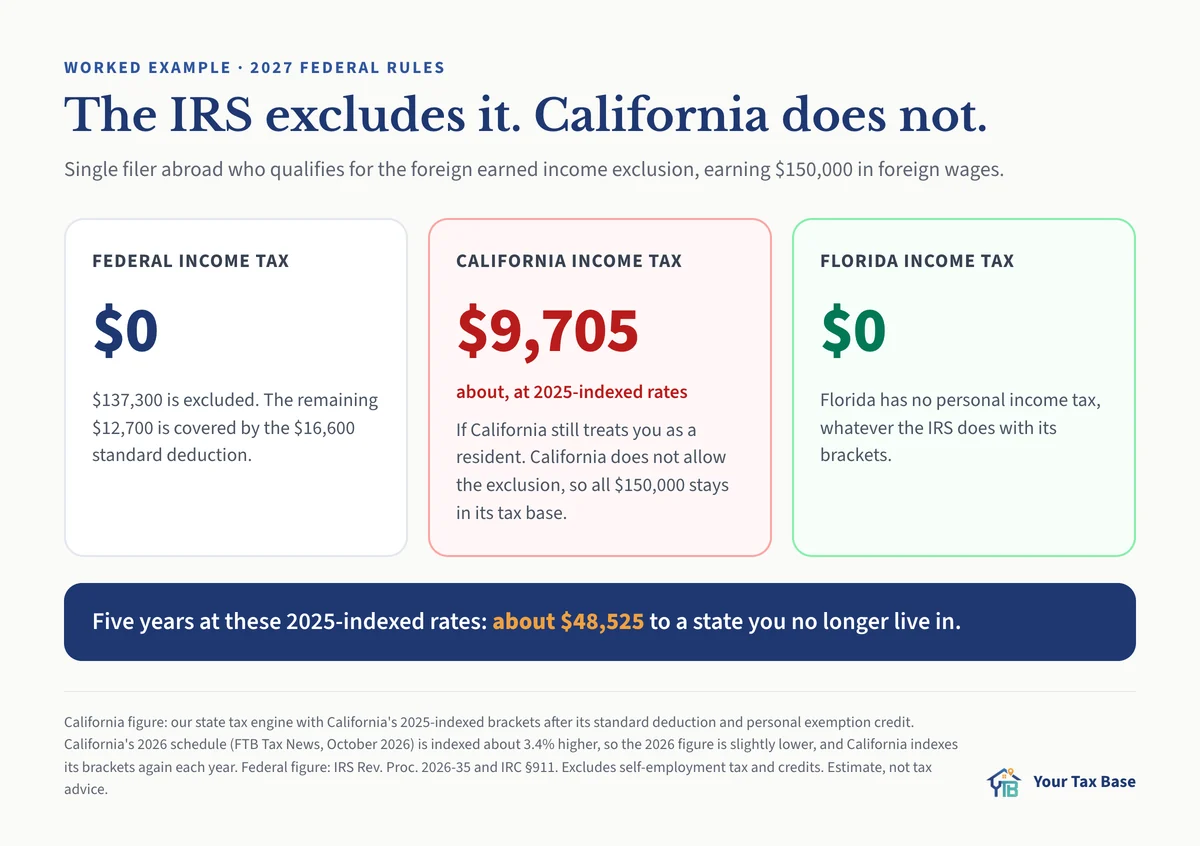
The foreign earned income exclusion for tax year 2027 is $137,300 per qualifying person, up $4,400 from 2026, under IRS Revenue Procedure 2026-35 released November 5, 2026. The standard deduction rises to $16,600 for single filers and $33,200 for married couples filing jointly, and every bracket threshold moves up while the seven rates stay at 10% to 37%. These figures apply to 2027 income on returns filed in 2028. The exclusion is a federal rule that covers foreign earned income only. California does not allow it, so a single Californian abroad with $150,000 of foreign wages can owe $0 in federal income tax and still about $9,705 to California (on its 2025-indexed brackets) if the state still treats them as a resident. The IRS just raised its 2027 limits. Your old state's claim on you may not have gone away.
Key Takeaways
The 2027 exclusion is $137,300
Rev. Proc. 2026-35 section 3.41 sets the 2027 maximum at $137,300 per qualifying person, up from $132,900 for 2026. If both spouses qualify, each can exclude up to $137,300 of their own foreign earned income.
It applies to 2027 income, filed in 2028
A return you file in 2027 reports 2026 income and uses $132,900. Match the figure to the tax year on Form 2555, not the year you file.
Every bracket moved up; the rates did not
The seven rates stay at 10% to 37%. For single filers the 22% bracket now starts above $52,025 and the 37% bracket above $661,375.
Excluded income still sets your bracket
Under the stacking rule in IRC 911(f), income above the exclusion is taxed at the rates it would face without the exclusion. A single filer with $200,000 of foreign wages owes $11,064 of federal income tax before any foreign tax credit, not $5,276.
The exclusion covers earned income, not investments
Interest, dividends, capital gains, pensions and Social Security are not foreign earned income. For 2027 the 0% long-term capital gains rate covers taxable income up to $51,050 single or $102,100 joint.
California, New Jersey, Massachusetts, Pennsylvania and Hawaii ignore the exclusion
California taxes its residents on the wages the IRS excludes, and so do New Jersey, Massachusetts, Pennsylvania and Hawaii. For a single filer with $150,000 of foreign wages, California takes about $9,705 a year on its 2025-indexed schedule if it still treats them as a resident, against $0 federal income tax.
Some thresholds are not indexed for inflation
The FBAR trigger stays at more than $10,000 in aggregate foreign accounts, and Form 8938 thresholds for filers abroad stay at $200,000 or $300,000 if you are unmarried or married filing separately.
Your state follows its own rules
Federal inflation adjustments do not change state residency, and most states set their own brackets. Moving your domicile to a state with no personal income tax, such as Florida, and cutting your old state's ties before 2027 is the step that can remove that line.
This article is part of our US Expat Tax Guide series. See also: Florida Residency for Expats
Disclaimer: This article explains the official 2027 figures for general education. It is not tax or legal advice. Your exclusion, credits and state residency depend on your facts, so confirm your situation with a qualified tax professional.
The foreign earned income exclusion for 2027 is $137,300 per qualifying person. The IRS announced it on November 5, 2026 in Revenue Procedure 2026-35, together with the 2027 tax brackets, a higher standard deduction and dozens of other inflation adjustments (IRS news release IR-2026-133).
Every 2027 inflation-adjusted figure below comes from that Revenue Procedure, checked line by line against the IRS PDF. Other figures cite their own sources, such as the Social Security Administration for the wage base. The federal news is good for Americans abroad: you can exclude $4,400 more of your foreign wages, and every bracket starts higher. Your former state is the part that usually did not change. The IRS adjusts federal amounts only, and the exclusion is a federal rule that some states, California first among them, do not follow.
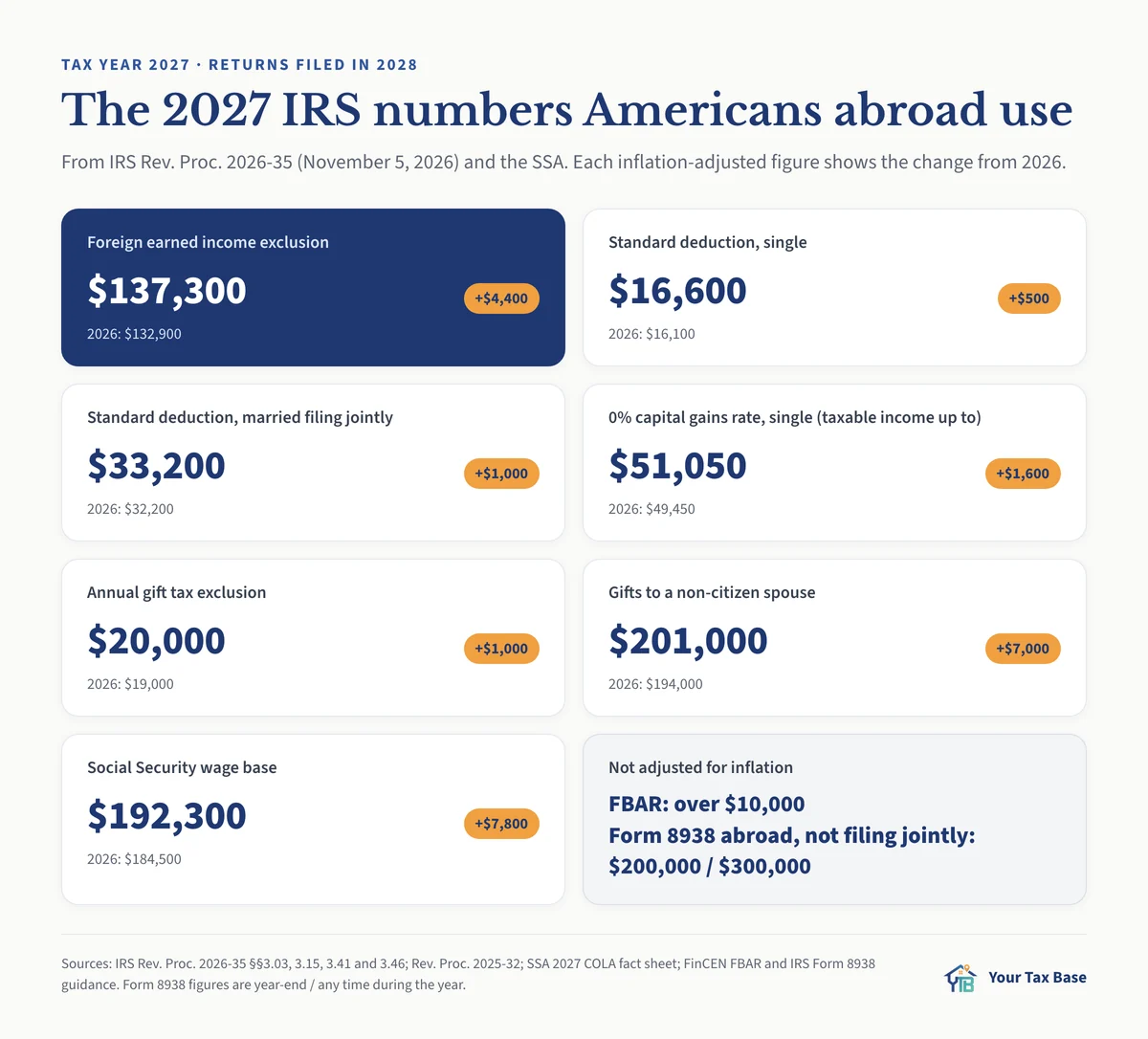
The 2027 numbers at a glance
Scroll the table sideways to see all columns.
| Figure | 2027 | 2026 | Rev. Proc. 2026-35 |
|---|---|---|---|
| Foreign earned income exclusion | $137,300 | $132,900 | Section 3.41 |
| Standard deduction, single or married filing separately | $16,600 | $16,100 | Section 3.15 |
| Standard deduction, married filing jointly | $33,200 | $32,200 | Section 3.15 |
| Standard deduction, head of household | $24,925 | $24,150 | Section 3.15 |
| 0% long-term capital gains rate, single (taxable income up to) | $51,050 | $49,450 | Section 3.03 |
| 0% long-term capital gains rate, joint (taxable income up to) | $102,100 | $98,900 | Section 3.03 |
| Annual gift tax exclusion | $20,000 | $19,000 | Section 3.46 |
| Annual gifts to a non-citizen spouse | $201,000 | $194,000 | Section 3.46 |
| Estate tax basic exclusion amount | $15,480,000 | $15,000,000 | Section 3.44 |
| Child tax credit, maximum per child (refundable part) | $2,300 ($1,800) | $2,200 ($1,700) | Section 3.05 |
| AMT exemption, unmarried / joint | $93,000 / $144,700 | $90,100 / $140,200 | Section 3.11 |
| Health FSA salary reduction limit (carryover) | $3,500 ($700) | $3,400 ($680) | Section 3.16 |
| Transit pass or qualified parking, per month | $350 | $340 | Section 3.18 |
| Social Security wage base (SSA) | $192,300 | $184,500 | SSA 2027 fact sheet |
In this guide:
- Which year the $137,300 applies to, and the figure to use on the return you file in 2027.
- Who qualifies for the 2027 exclusion, and what it does not cover.
- The full 2027 tax brackets for expats, and the stacking rule that keeps excluded income in your bracket.
- The standard deduction and other 2027 thresholds Americans abroad use, plus the ones that are not indexed for inflation.
- The state tax the exclusion does not reach, with a worked California example and a calculator for your own state.
Run your 2027 numbers
This calculator uses the 2027 brackets, standard deduction and $137,300 exclusion from Rev. Proc. 2026-35, with the same engine as our full US expat tax calculator. Enter your foreign earned income and the state you are still tied to.
2027 expat tax calculator
Your 2027 federal tax with the $137,300 exclusion, and what your state still takes
Excluded by the FEIE
$137,300
2027 federal income tax
$0
$24,375 without the exclusion
California income tax
$9,705
Florida: $0
The IRS raised its 2027 limits. If California still treats you as a resident, it takes about $9,705 a year, roughly $48,525 over five years.
Federal figures use IRS Rev. Proc. 2026-35 (tax year 2027): brackets, standard deduction and the $137,300 exclusion, with the stacking rule that taxes your remaining income at the rates it would face without the exclusion. Wages only; excludes self-employment tax, credits and the foreign tax credit. State tax uses the schedules in our state tax engine (2026 for most states; California's brackets are 2025-indexed) because many states have not released 2027 brackets; head of household uses single-filer state brackets in most states. For married couples, this applies one $137,300 exclusion to one spouse's income; each qualifying spouse has their own. California, Hawaii, Massachusetts, New Jersey and Pennsylvania do not allow the exclusion, so their tax is figured on your full income. Estimate only, not tax advice.
Which year does the $137,300 exclusion apply to?
The $137,300 figure applies to income you earn in calendar year 2027, which you report on the return you file in 2028. The return most Americans abroad file in 2027 covers 2026 income and uses the 2026 maximum of $132,900. Our 2026 foreign earned income exclusion guide covers that filing season.
| Tax year (income earned) | Maximum exclusion | Return usually filed in |
|---|---|---|
| 2025 | $130,000 | 2026 |
| 2026 | $132,900 | 2027 |
| 2027 | $137,300 | 2028 |
The figure is a ceiling, not an automatic amount. You exclude the smaller of your qualifying foreign earned income or the maximum. If your qualifying period covers only part of 2027, the maximum is limited to the share of 2027 days inside that period: 300 qualifying days, for example, allow 300/365 of $137,300.
Who qualifies for the 2027 foreign earned income exclusion?
The rules did not change for 2027; only the dollar amount did. Under IRC 911 and IRS Publication 54, you need all three of the following:
- Foreign earned income: pay for work you personally perform in a foreign country, as an employee or self-employed. Pay from the US government or its agencies does not count, even when earned abroad.
- A tax home in a foreign country: your main place of work is abroad, and your abode is not in the United States.
- One of two tests: the physical presence test (at least 330 full days in foreign countries during any 12 consecutive months) or the bona fide residence test (an uninterrupted period of residence abroad that includes an entire tax year).
Why this matters: the exclusion only ever covers earned income. Interest, dividends, capital gains, rental income, pensions, annuities, IRA withdrawals and Social Security benefits are not excluded. They stay taxable under the normal federal rules (up to 85% of Social Security benefits, for example) and under the rules of any state that still treats you as a resident.
Free tool
Will you hit 330 days in 2027?
Use our FEIE physical presence calculator. Enter your stays abroad and it counts your full days in your best 12-month period, so you can compare the total with the 330-day test before you book a long visit home.
2027 tax brackets for expats
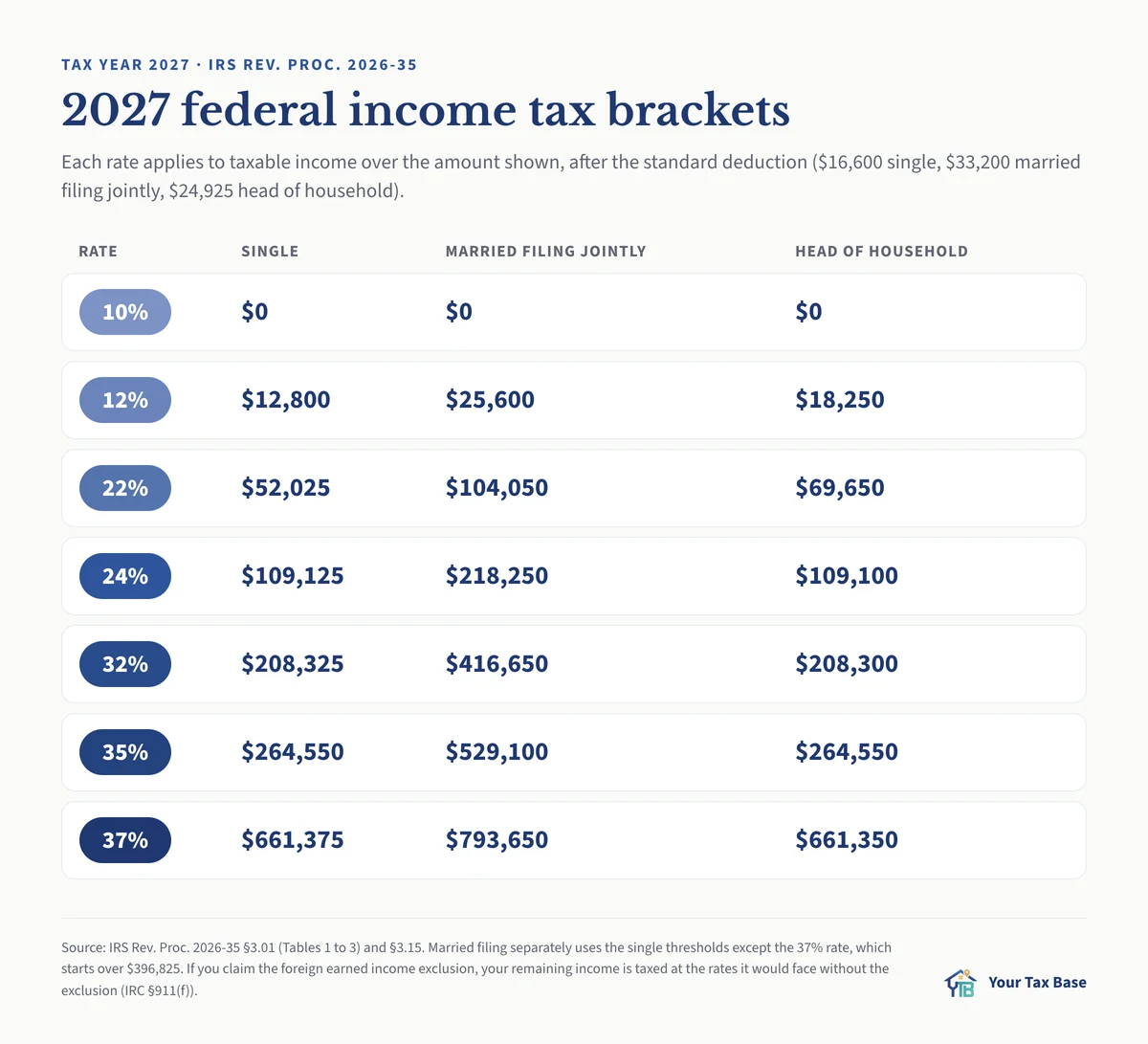
Americans abroad use the same 2027 brackets as everyone else. The seven rates stay at 10%, 12%, 22%, 24%, 32%, 35% and 37%, and each threshold rose by about 3% (Rev. Proc. 2026-35, section 3.01). Each rate applies to taxable income above the amount shown, after the standard deduction.
Scroll the table sideways to see all filing statuses.
| Rate | Single | Married filing jointly | Head of household | Married filing separately |
|---|---|---|---|---|
| 10% | $0 | $0 | $0 | $0 |
| 12% | over $12,800 | over $25,600 | over $18,250 | over $12,800 |
| 22% | over $52,025 | over $104,050 | over $69,650 | over $52,025 |
| 24% | over $109,125 | over $218,250 | over $109,100 | over $109,125 |
| 32% | over $208,325 | over $416,650 | over $208,300 | over $208,325 |
| 35% | over $264,550 | over $529,100 | over $264,550 | over $264,550 |
| 37% | over $661,375 | over $793,650 | over $661,350 | over $396,825 |
Why excluded income still sets your bracket (the stacking rule)
The exclusion takes income out of your tax base, but not out of your bracket. Under IRC 911(f), the income left after the exclusion is taxed at the rates that would apply if the excluded amount were still included. The IRS applies this through the Foreign Earned Income Tax Worksheet in the Form 1040 instructions.
Take a single filer abroad with $200,000 of foreign wages in 2027:
- Excluded: $137,300. Left after the $16,600 standard deduction: $46,100.
- If that $46,100 were taxed from the bottom brackets, the tax would be $5,276.
- With the stacking rule, it is taxed as if the excluded income were still there, which puts all of it in the 24% bracket: $11,064.
- Without the exclusion at all, the tax would be $36,375, so the exclusion lowers this filer's federal income tax by $25,311 compared with no exclusion and no credit.
The same rule pushes capital gains and qualified dividends into higher capital gains brackets, so investment income can cost more than the 0% headline suggests once you claim the exclusion.
2027 standard deduction for Americans abroad
The 2027 standard deduction is $16,600 for single filers and married filing separately, $33,200 for married filing jointly and $24,925 for heads of household (Rev. Proc. 2026-35, section 3.15). Add $2,100 for each of age 65 or older and blindness if you are unmarried and not a surviving spouse, or $1,700 per condition for each married spouse or a surviving spouse.
- Married to a non-citizen spouse: a US citizen married to a nonresident alien generally files as married filing separately, with the $16,600 deduction, or as head of household with another qualifying person, unless the couple elects to treat the spouse as a US resident and file jointly. That election brings the spouse's worldwide income into the US return for that year and later years until it ends, so run both versions before choosing.
- Age 65 and older: separate from the standard deduction, eligible taxpayers can deduct up to $6,000 each for 2025 through 2028 under IRC 151(d)(5)(C). It phases out by 6% of modified adjusted gross income above $75,000, or $150,000 joint, and for this test modified adjusted gross income adds back excluded foreign earned income. A valid Social Security number is required, and married couples must file jointly.
YOUR STATE TAX IN 2027
The IRS raised its 2027 limits. Your old state may not follow.
In California, New Jersey, Massachusetts, Pennsylvania and Hawaii, the $137,300 exclusion stops at the federal return. Your Tax Base helps you move your US home base to Florida, a state with no personal income tax: a real Florida residential address, guidance for your Florida driver's license, voter registration and address records, and your IRS and state mail scanned to your dashboard.
Other 2027 numbers Americans abroad should know
2027 capital gains brackets
Long-term capital gains and qualified dividends are taxed at 0% up to $51,050 of taxable income for single filers ($102,100 joint, $68,350 head of household), 15% up to $563,200 ($633,600 joint, $598,400 head of household) and 20% above that (Rev. Proc. 2026-35, section 3.03). The exclusion never applies to gains, and the stacking rule above can move them up a bracket.
2027 gift and estate figures
- Annual gift exclusion: $20,000 per recipient.
- Gifts to a spouse who is not a US citizen: $201,000 a year. Gifts between US-citizen spouses are unlimited, so this cap matters to many expat couples.
- Estate tax basic exclusion amount: $15,480,000 for estates of people who die in 2027 (section 3.44).
2027 foreign housing exclusion
The housing exclusion lets you exclude part of your foreign housing costs on top of the $137,300. The base amount is 16% of the exclusion and the general cap on housing expenses is 30% of it, both figured per qualifying day. By that statutory formula, a full 2027 year gives a base of $21,968 and a cap of $41,190, so the most you can exclude in a standard location is $19,222. Self-employed people take a housing deduction instead. Higher caps for high-cost cities come in a separate IRS notice each year; the 2026 list is Notice 2026-25, and the 2027 list had not been published as of November 9, 2026.
2027 credits and payroll figures
- Child tax credit: up to $2,300 per qualifying child, with up to $1,800 refundable (section 3.05). If you file Form 2555, you cannot claim the refundable part, per the Schedule 8812 instructions.
- Self-employment tax: the exclusion does not reduce it. The Social Security part applies up to the 2027 wage base of $192,300 (SSA 2027 fact sheet), unless a totalization agreement covers you in another country.
2027 alternative minimum tax (AMT) exemption
The 2027 AMT exemption is $93,000 for unmarried filers, $144,700 for joint filers and $72,350 for married filing separately. It phases out above $515,950 of alternative minimum taxable income for unmarried filers and married filing separately, and above $1,031,900 for joint filers. The 28% AMT rate applies to alternative minimum taxable income above $252,500 after the exemption ($126,250 married filing separately) (Rev. Proc. 2026-35, section 3.11). If you claim the exclusion, the Form 6251 instructions use their own Foreign Earned Income Tax Worksheet (line 7), which stacks excluded income the same way, so excluded income also sets your AMT rate.
2027 employer benefit limits if you are on a US payroll
If you work abroad for a US employer that offers these plans, the 2027 limits rise too. You can put up to $3,500 of salary into a health flexible spending arrangement, and up to $700 of unused money can carry over if your plan allows it (section 3.16). The tax-free transit pass and qualified parking benefits are each $350 a month (section 3.18).
2027 figures for anyone considering renouncing
- Covered expatriate tax test: average annual net income tax of more than $218,000 for the five prior years (section 3.39). The net worth and certification tests are separate.
- Mark-to-market exclusion: $940,000 (section 3.40).
- Passport threshold: the State Department can deny or revoke a passport once the IRS certifies a seriously delinquent tax debt of more than $68,000 for 2027 (section 3.65).
What did not change for 2027
Two reporting thresholds are fixed and do not adjust for inflation:
- FBAR: required when your foreign financial accounts total more than $10,000 at any time during the year (IRS FBAR guidance).
- Form 8938 for taxpayers living abroad: if your tax home is in a foreign country and you meet the bona fide residence or physical presence test, the thresholds are more than $200,000 at year end or $300,000 at any time if not filing jointly, and $400,000 or $600,000 on a joint return (IRS comparison of Form 8938 and FBAR; Form 8938 instructions).
What the 2027 adjustments do not touch: your state tax
Revenue Procedure 2026-35 adjusts federal amounts only. Each state sets its own brackets on its own schedule, and many states that index their brackets have not published 2027 figures yet. The exclusion is also a federal rule, and states decide for themselves whether to follow it.
California does not. California does not allow the federal foreign earned income or housing exclusion, so a California resident adds the excluded amount back on Schedule CA (540), line 8d. The IRS can tax your foreign wages at nothing while California taxes all of them.
California is not alone. Under their own official instructions, residents of four more states also pay state tax on the wages the IRS excludes:
- New Jersey: taxable income includes "income earned by a resident from foreign employment" (NJ-1040 instructions).
- Massachusetts: compensation excluded under IRC 911 must be included on Form 1, line 3 (Form 1 instructions).
- Pennsylvania: foreign earned income excluded federally is taxable compensation for Pennsylvania (PA withholding guide, Appendix Part A).
- Hawaii: residents add the exclusion back "because Hawaii does not have this exclusion" (Form N-11 instructions).
Three points decide whether your state still reaches you in 2027:
- Residency comes first. A state can only tax your worldwide income as a resident if it still treats you as one. Most states treat you as a resident while your domicile, your true legal home, stays there, even if you live abroad. California's safe harbor is narrow: a domiciliary outside California under an employment-related contract for at least 546 consecutive days is treated as a nonresident, with limits on return visits and intangible income, and not if avoiding tax is the main purpose of the absence (FTB Publication 1031). The FTB has ruled that an independent-contractor arrangement can count (Chief Counsel Ruling 2000-01), but people with no work contract, such as most retirees, cannot use it. Outside the safe harbor, the FTB decides on the facts whether your absence is temporary. A few states go the other way: Oregon, for example, generally treats a domiciliary who meets the federal exclusion tests as a nonresident (Oregon Publication OR-17).
- Conformity comes second. In states that start from federal adjusted gross income with no add-back, such as New York, the excluded wages generally drop out of the state base too. In the five states above they do not.
- Investment income is outside the exclusion everywhere. Even where the exclusion flows through, a resident state can tax your interest, dividends, capital gains and rental income, and often part of your retirement income, depending on its own rules. California, for example, excludes Social Security but taxes pensions and IRA withdrawals.
Read do expats pay state taxes for the state-by-state picture, and how to prove a domicile change in an audit for what states check.
See what your state's latest schedule in our tax engine takes on income it can tax:
Live Savings Calculator
What does staying in your state actually cost?
Current state tax
$9,705
Florida tax
$0
Net first-year savings
$9,045
That's ≈ $97,050 over 10 years, before plan cost.
Single filer estimate from your state's 2026 income tax rate schedule after its standard deduction, before credits (California uses the latest published 2025-indexed brackets). State income tax only, less $660 annual YourTaxBase plan cost. Estimate only, not tax advice.
Before 2027 starts
The IRS raised its 2027 limits. Your old state may not follow. Move your US home base to Florida, a state with no personal income tax, with most of the setup done from abroad: a real Florida residential address, guidance for your Florida driver's license and voter registration, and your IRS and state mail scanned to your dashboard.
Get your Florida address How Florida domicile works for expatsHow to plan for 2027 if you live abroad
- Pick your test and track your days: decide whether you will rely on the 330-day physical presence test or bona fide residence, and count your full days abroad with the FEIE calculator.
- Compare the exclusion with the foreign tax credit: in higher-tax countries the credit can beat the exclusion. See our foreign tax credit guide.
- Budget for investment income: the exclusion never covers gains, interest or dividends, and the stacking rule can push them out of the 0% bracket.
- Check self-employment tax: freelancers generally owe it on excluded income unless a totalization agreement applies.
- Review gifts to a non-citizen spouse: keep annual transfers within $201,000 or plan the gift tax return.
- Calendar your reporting: FBAR above $10,000 and Form 8938 at the thresholds for filers abroad.
- Settle your state residency before the year starts: document your domicile in a state with no personal income tax, such as Florida, with your address, driver's license and voter registration. Our Florida domicile service for expats handles most of the setup from abroad; the Florida driver's license needs one in-person visit.
- Make sure IRS and state letters reach you: notices have deadlines that do not wait for forwarded mail. A virtual mailbox scans them to your dashboard.
Frequently asked questions
What is the foreign earned income exclusion for 2027?
$137,300 per qualifying person, under IRS Revenue Procedure 2026-35, section 3.41. It was $132,900 for 2026 and $130,000 for 2025, and it applies to 2027 income reported in 2028.
Is the 2027 FEIE $137,300 per person or per couple?
Per person. If both spouses qualify, each can exclude up to $137,300 of their own foreign earned income, for up to $274,600 together. One spouse cannot use the other's unused exclusion.
What are the 2027 tax brackets for expats?
The same brackets as for everyone: for single filers, 12% above $12,800, 22% above $52,025, 24% above $109,125, 32% above $208,325, 35% above $264,550 and 37% above $661,375. The stacking rule taxes income above the exclusion at those higher rates.
Does the foreign earned income exclusion apply to state taxes?
It depends on the state. California, New Jersey, Massachusetts, Pennsylvania and Hawaii do not allow it. States that follow federal adjusted gross income generally let the excluded wages drop out, but the exclusion never covers investment or retirement income, and the first question is whether your former state still treats you as a resident.
What is the annual gift exclusion for 2027?
$20,000 per recipient, and $201,000 for gifts to a spouse who is not a US citizen.
When do I file my 2027 taxes?
In 2028. If your tax home and abode are outside the United States and Puerto Rico on the regular due date, you get an automatic two-month extension to file and pay, though interest on unpaid tax runs from the regular due date.
Start 2027 with a home base that does not tax you. Your Tax Base helps you establish your Florida domicile, with most steps done from wherever you live: a real Florida residential address, step-by-step guidance for your license, voter registration and address records, and a virtual mailbox for the letters that matter.
Get your Florida address See plans and pricingRelated guides
Expat tax and filing
- Pillar: US expat tax guide
- Foreign earned income exclusion 2026: limit and who qualifies
- Foreign tax credit guide
- US expat filing checklist
- Digital nomad tax planning and the FEIE
- US expat tax reform: what is law and what is pending
State residency while abroad
- Do expats pay state taxes?
- How to change state residency while living abroad
- How to legally leave California taxes
- Service: Florida domicile for expats
Free tools
Authority references cited
- IRS Revenue Procedure 2026-35 (tax year 2027 inflation adjustments)
- IRS news release IR-2026-133, November 5, 2026
- IRS Revenue Procedure 2025-32 (tax year 2026 figures)
- IRC 911, citizens or residents living abroad
- IRS Publication 54, Tax Guide for U.S. Citizens and Resident Aliens Abroad
- Instructions for Form 2555
- Form 1040 instructions, Foreign Earned Income Tax Worksheet
- Schedule 8812 instructions
- Form 6251 instructions, alternative minimum tax
- Treas. Reg. 1.6081-5, automatic extension for taxpayers abroad
- IRS Notice 2026-25, 2026 foreign housing limits
- IRC 151(d)(5)(C), deduction for seniors
- California Schedule CA (540) instructions
- FTB Publication 1031, guidelines for determining resident status
- SSA 2027 COLA fact sheet
- IRS FBAR guidance, comparison of Form 8938 and FBAR and Form 8938 instructions
Educational information as of November 2026, based on IRS Revenue Procedure 2026-35. Your Tax Base provides domicile establishment services but is not a law firm, CPA firm, or registered tax advisory service. Consult a qualified tax professional about your exclusion, elections, reporting and state residency.
Frequently asked questions
- What is the foreign earned income exclusion for 2027?
- The 2027 foreign earned income exclusion is $137,300 per qualifying person, set by IRS Revenue Procedure 2026-35, section 3.41, released November 5, 2026. It was $132,900 for 2026 and $130,000 for 2025. It applies to 2027 income reported on returns filed in 2028.
- Is the 2027 FEIE $137,300 per person or per couple?
- Per person. Each spouse who qualifies can exclude up to $137,300 of their own foreign earned income, so a couple where both qualify and each earns at least that much can exclude up to $274,600. One spouse cannot use the other spouse's unused exclusion.
- What are the 2027 tax brackets for expats?
- Americans abroad use the same 2027 brackets as everyone else. For single filers the 12% rate starts above $12,800, 22% above $52,025, 24% above $109,125, 32% above $208,325, 35% above $264,550 and 37% above $661,375. Joint filers start at $25,600, $104,050, $218,250, $416,650, $529,100 and $793,650. If you claim the exclusion, IRC 911(f) taxes your remaining income at the rates it would face without the exclusion.
- What is the 2027 standard deduction?
- For 2027 the standard deduction is $16,600 for single filers and married filing separately, $33,200 for married filing jointly and $24,925 for heads of household (Rev. Proc. 2026-35, section 3.15). The additional amount for being 65 or older, and again for being blind, is $2,100 for unmarried filers who are not surviving spouses and $1,700 for married filers and surviving spouses.
- Does the foreign earned income exclusion apply to state taxes?
- It depends on the state. The exclusion is a federal rule. California, New Jersey, Massachusetts, Pennsylvania and Hawaii do not allow it, so their residents pay state tax on the excluded wages. Even in states that follow federal adjusted gross income, the exclusion never covers interest, dividends, capital gains or retirement income. The bigger question is whether your former state still treats you as a resident at all.
- What is the annual gift tax exclusion for 2027?
- The 2027 annual gift tax exclusion is $20,000 per recipient, up from $19,000 (Rev. Proc. 2026-35, section 3.46). Gifts to a spouse who is not a US citizen have a separate annual exclusion of $201,000 for 2027, up from $194,000.
- Can I claim the foreign earned income exclusion and the child tax credit?
- You can claim the nonrefundable child tax credit, which is up to $2,300 per qualifying child for 2027. It phases out above $200,000 of modified adjusted gross income ($400,000 on a joint return), and for this test modified adjusted gross income adds back excluded foreign earned income; Social Security number rules also apply. If you file Form 2555 to claim the exclusion, you cannot claim the refundable part of the credit, which is up to $1,800 per child for 2027.
- Does the foreign earned income exclusion reduce self-employment tax?
- No. The exclusion reduces income tax only. Self-employed Americans abroad still owe self-employment tax unless a totalization agreement assigns their coverage to another country. For 2027 the Social Security part applies to net earnings up to the $192,300 wage base.
- When do I file my 2027 taxes?
- Tax year 2027 returns are filed in 2028. If your tax home and abode are outside the United States and Puerto Rico on the regular due date, you get an automatic two-month extension to file and pay, and interest on any unpaid tax still runs from the regular due date.
- What is the 2027 foreign housing exclusion limit?
- The housing base is 16% of the exclusion and the general cap on housing expenses is 30% of it. For a full 2027 year that formula gives a base of $21,968 and a cap of $41,190, so the most you can exclude in a standard location is $19,222. The IRS publishes higher limits for high-cost cities in a separate notice; the 2027 list had not been published as of November 9, 2026.
- Who gets the $6,000 senior deduction in 2027?
- US taxpayers age 65 or older can deduct up to $6,000 each for 2025 through 2028. It phases out by 6% of modified adjusted gross income above $75,000, or $150,000 on a joint return, and modified adjusted gross income adds back excluded foreign earned income. You need a valid Social Security number, and married couples must file jointly.
- Can Your Tax Base help with my state taxes while I use the exclusion?
- Your Tax Base does not prepare tax returns; your tax preparer handles Form 2555. Your Tax Base helps you establish Florida domicile, with most steps handled from abroad: a real Florida residential address, guidance for your Florida driver's license, voter registration and address records, and a virtual mailbox that scans your mail, so your US home base sits in a state with no personal income tax.
Ready to make Florida your base?
Until you change it, your old state is still your domicile, and the burden of proving you changed it falls on you. We give you a real Florida street address, the paperwork that backs it up, and mail that follows you anywhere.
Billed annually, charged once. Cancel your renewal anytime. Or talk to us first
Stay Updated on State Tax and Residency Rules
Get monthly tax tips, IRS updates, and compliance reminders delivered to your inbox.
No spam. Unsubscribe anytime.
Related Articles
US Expat Tax Reform (2026): Did Trump End Double Taxation?
Trump promised to end double taxation for Americans abroad. Here is what is already law, what the Senate passed, and what remains a proposal, with the original bills, IRS guidance and the mail deadlines you still need to track.
Read ArticleCan I Use My Parents' US Address While Living Abroad?
Your parents can receive your mail, but your address, paperwork and state ties still need a plan. See when a family address works and how Your Tax Base handles your Florida home base from setup through ongoing mail and support.
Read ArticleNotarizing US Documents From Abroad: Why Identity Verification Fails and What to Do Instead
Remote online notarization is supposed to let Americans overseas sign US documents from anywhere. For long-term expats it often stops before it starts, because the identity check cannot generate questions about someone with no recent US data footprint. Florida law addresses this failure directly: if the databases do not hold enough information to authenticate you, the notary may not proceed. This guide explains the statutory requirements, why the wall exists, and the routes that still work.
Read ArticleForeign Earned Income Exclusion: 2026 Eligibility and Limit
The foreign earned income exclusion is an election for qualifying foreign earned income. For tax year 2026, its maximum is $132,900 per qualifying person, subject to the qualifying period and other limits. Living overseas alone does not establish eligibility.
Read ArticleDo Expats Pay State Taxes? Complete 2026 Guide
Do expats pay state taxes? Yes, if domiciled in CA, NY, or other high-tax states. Learn how to legally eliminate state taxes by establishing Florida residency before moving abroad.
Read ArticleUS Expat Filing Checklist: Returns and Foreign Accounts
An expat filing checklist should separate the income-tax return from foreign-account and entity reporting. A zero balance due on Form 1040 does not, by itself, remove the obligation to file either category.
Read ArticleRelated Services
Florida Residency for Expats
Maintain US ties while abroad. Florida address, mail forwarding, and tax documentation.
Learn MoreUS Expat Tax Calculator
Calculate federal taxes with FEIE ($132,900 exclusion) and Foreign Tax Credit.
Learn More