Can You Keep Florida Residency After Selling Your House? The 2027 Guide for Full-Time Travelers
Selling your Florida house to travel full time does not, by itself, end your Florida domicile. A May 2026 Third District Court of Appeal decision reaffirmed that an established domicile continues until a new one replaces it. What the sale does change is every record that pointed at the house: your driver license address (30 days to fix under Fla. Stat. 322.19), your voter registration, your mail, your banks, the IRS and Social Security. This guide separates mailing address, residential address and domicile, walks through the statutes, and gives you the before-closing checklist.

 By Justin Malone, Co-Founder & CEO
Sources and review notes
Reviewed against primary Florida and federal authorities, including Fla. Stat. 196.015, 322.08, 322.19, 101.045 and 222.17; Fla. Const. art. VII, sec. 5; Oliveira v. Oliveira, No. 3D25-0855 (Fla. 3d DCA May 13, 2026), including its citations to Keveloh v. Carter, 699 So. 2d 285 (Fla. 5th DCA 1997) and Weiler v. Weiler, 861 So. 2d 472 (Fla. 5th DCA 2003); USPS Domestic Mail Manual 508.1.8 and PS Form 1583; IRS guidance on address changes and Form 8822; Social Security Administration change-of-address guidance; and FLHSMV Form 71120, all checked September 2026.
Quick Summary
If Florida is already your domicile, selling the house and hitting the road does not move your domicile anywhere. Florida's Third District Court of Appeal said so again on May 13, 2026, in Oliveira v. Oliveira: once established, a domicile continues until it is superseded by a new one, and the party claiming you left carries the burden of proving it. That ruling held for a man with five homes and three companies in Brazil. What the closing does destroy is the address on your driver license, voter record, IRS file, bank accounts and insurance. Florida gives you 30 calendar days to replace the license address under Fla. Stat. 322.19, and 101.045 keeps a Floridian with no permanent address in the county on the voter roll. Sort your mail, your residential-address documentation and your domicile evidence before closing, because the state where you spend your longest stretch is the one that will argue Florida was never really home.
Key Takeaways
Selling the house does not sell your domicile
Florida courts presume an established domicile continues until a new one replaces it. In Oliveira v. Oliveira (May 2026) the Third District Court of Appeal held Florida domicile survived a family move to Brazil, Brazilian schools for the children, and a Florida condo under contract for sale.
Mailing address, residential address and domicile are three different questions
Fla. Stat. 322.08(2)(a) requires a driver license applicant to give both a mailing address and proof of residential address. A forwarding address answers the first question, not the second, and neither one settles domicile on its own.
You have 30 calendar days to fix the license
Fla. Stat. 322.19(2) requires a replacement license or ID card within 30 calendar days of a change to the legal residence or mailing address on file. If someone else certifies your address on Form HSMV 71120, they attest that you actually reside there.
Florida already has a voter-roll slot for travelers with no permanent address
Fla. Stat. 101.045(3) registers a person who is temporarily outside the county with no permanent address there, and who intends to remain a Florida and county resident, in the precinct containing the Supervisor of Elections main office. The trade-off is no municipal elections.
Homestead and domicile are not the same thing
The homestead exemption ends with the property. Domicile does not. In Oliveira the trial court read the unsold condo and the children's earlier Florida schooling as historical evidence of Florida domicile, and the appellate court affirmed that reading.
A Declaration of Domicile is evidence, not magic
Fla. Stat. 222.17 asks you to swear where you reside and maintain a place of abode. If your recorded declaration names the house you sold, ask the clerk or a Florida attorney whether a fresh filing fits your facts.
A mailbox is not a domicile
A separate USPS-registered mailbox you authorize with PS Form 1583 solves mail delivery. The Oliveira court added, in a footnote, that an address does not necessarily equate to domicile.
Other states keep their own tests
Florida domicile does not stop New York, California or any other state from applying its own statutory-residency or closest-connection rules to the months you spend there. Track your days.
This article is part of our Florida Residency Guide series. See also: Florida Residency for RVers
Read this first: This article is for educational purposes only and does not constitute legal, tax, or financial advice. Domicile is a fact-specific question, government agencies and financial institutions set their own documentation rules, and another state or country may apply its own residency tests. Every statute and case below is linked to its primary source as of September 2026. Consult a Florida attorney or a CPA before making domicile decisions.
The closing is scheduled. The RV is bought, or the boat is provisioned, or the one-way ticket is booked. Then the question that nobody at the title company can answer: if you already live in Florida, sell your house and travel full time, can you keep Florida residency after selling your house?
The short answer is that selling the house does not, by itself, end your Florida domicile. A Florida appellate court reaffirmed that principle in May 2026. The longer answer is that the sale erases the address on nearly every record you own, and the work of replacing it correctly is where travelers get into trouble.
This guide is for retirees, early retirees, RVers, boaters, digital nomads and Americans who plan to spend a few years on the move before settling back in Florida. It covers:
- Why an established Florida domicile survives the sale, and what the 2026 Oliveira decision actually held
- The difference between a mailing address, a residential address and a domicile, and why they can have three different answers
- What Florida law requires for your driver license, your voter registration and your Declaration of Domicile once the house is gone
- A before-closing checklist that covers mail, the IRS, Social Security, banks, insurance and evidence
Who this is for
This guide assumes Florida is already your home. If you are still deciding whether to make it home, start with our Florida residency guide. If you are already planning the road or the water, the RVer and retiree service pages show how the address, mail and paperwork fit together.
The short answer: selling your house does not end Florida domicile
If Florida is already your established domicile, selling your Florida house and traveling does not necessarily establish a new domicile somewhere else.
Florida's Third District Court of Appeal reaffirmed that principle on May 13, 2026, in Oliveira v. Oliveira, No. 3D25-0855, a probate dispute over a Florida domiciliary with extensive ties to Brazil. The court explained that a person may maintain several residences but can only have one domicile, and, quoting Keveloh v. Carter, that "once established, a domicile continues until it is superseded by a new one." The burden of proof rests on the party claiming that a domicile was abandoned.
That does not mean you can keep using the address of a house you sold, or put a mailbox address on every form. It means you should separate three questions that travelers tend to blur together:
- Where will my mail be delivered?
- What residential address does a particular agency or institution require?
- What place remains my permanent legal home, my domicile?
Those questions can have different answers, and the rest of this guide takes them one at a time.
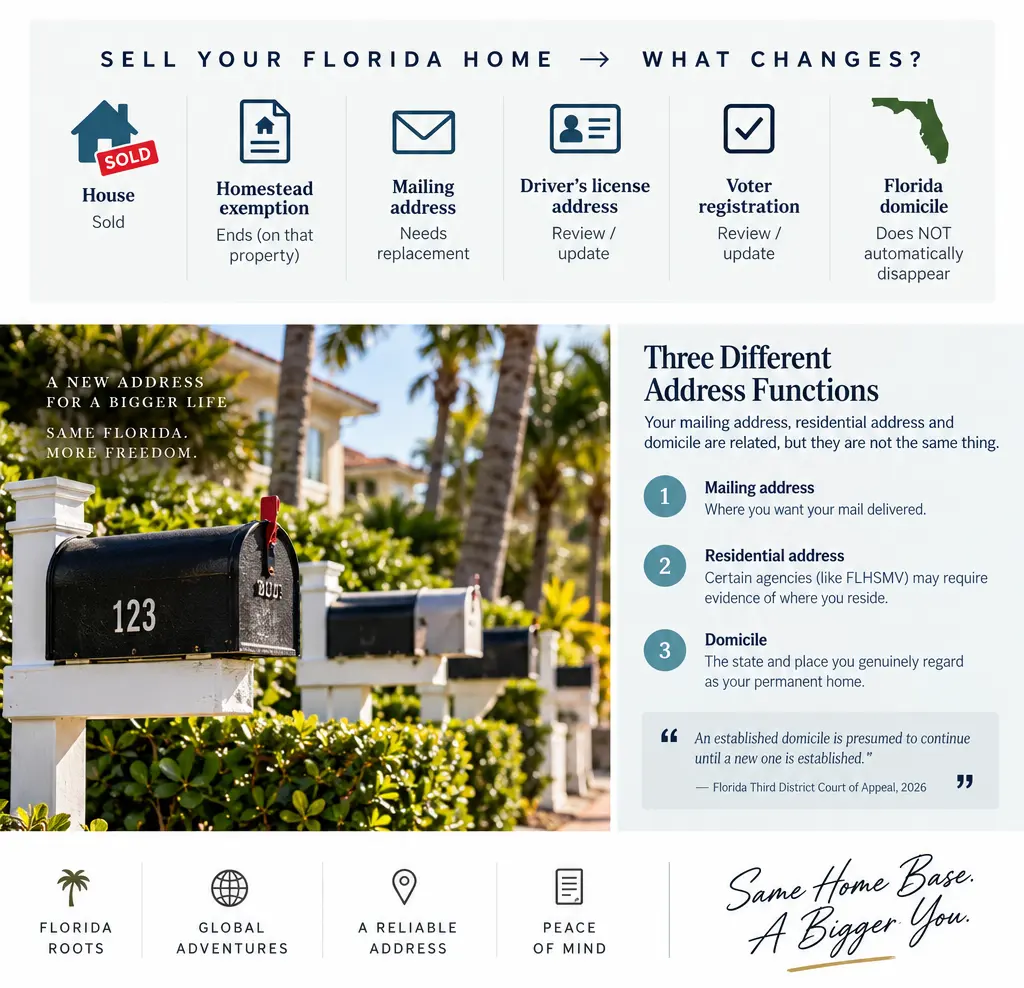
Can you be a Florida resident without owning a house?
Potentially, yes. Florida has no rule that says owning real estate makes you a domiciliary, and no rule that says selling it un-makes you. Domicile is determined by your circumstances and your intent to make a particular place your permanent home.
The clearest illustration of the kind of facts Florida officials weigh is in the homestead statute. Florida Statutes §196.015 says that intention to establish a permanent residence is a factual determination and that no single factor is conclusive. The relevant factors the statute lists include:
- A formal Declaration of Domicile recorded in the county public records
- Where dependent children are registered for school
- Place of employment
- The previous permanent residence outside Florida and the date that residency ended
- Florida voter registration with the voter information card address matching the physical location
- A valid Florida driver license or identification card, with evidence that any other state's license was relinquished
- A Florida license tag on a motor vehicle owned by the applicant
- The address listed on federal income tax returns
- Where bank statements and checking accounts are registered
- Proof of payment for utilities at the property for which permanent residency is claimed
That statute concerns homestead determinations by the property appraiser, so it is not a universal checklist that decides every domicile question. But it demonstrates the principle that runs through Florida law: residency is evaluated from an overall pattern of facts, not from whether your name appears on a deed. Our Florida domicile checklist walks through building that pattern from scratch; this guide is about keeping it intact when the biggest single piece, the house, comes out.
What the 2026 Oliveira decision means for full-time travelers
In Oliveira v. Oliveira, decided May 13, 2026, the Third District Court of Appeal considered whether a man remained domiciled in Florida or had shifted his domicile to Brazil before his death. His adult daughters from a prior relationship wanted the Florida probate converted to an ancillary proceeding, which required showing he was domiciled in Brazil. His wife, the personal representative, said Florida.
The facts were complicated. The decedent was a pilot and entrepreneur who had obtained an EB-5 visa and then a green card, extended for forty-eight months in January 2023. For several years the family had lived together in Coconut Grove, and the children attended Miami schools. He held a Florida driver license and a Florida vehicle insurance policy, kept his personal property in storage in Florida, and paid federal income tax as a legal resident.
But he also:
- Owned five single-family residences in Brazil, interests in three Brazilian companies, and four aircraft, all hangared in Brazil
- Traveled to Brazil extensively to oversee those businesses
- Returned to Brazil with his family in January 2023 and enrolled the children in local schools
- Spent only ten days of 2023 in Florida
- Listed his Coconut Grove condominium for sale on April 19, 2023, signed a sales contract ten days later, and died the next day in an aircraft accident in Brazil
Despite those ties, the court upheld the finding that Florida remained his domicile. Three parts of the reasoning matter for anyone selling a Florida home to travel:
Why this matters: the court said a domicile determination "requires a totality of the circumstances approach weighing a constellation of facts and evidence of intent." It quoted the rule that once domicile is established it continues until a new one supersedes it, and that the burden falls on the party asserting abandonment.
It also affirmed how the trial court read the unsold condo and the children's earlier Florida schooling: as historical evidence of Florida domicile, not as proof that a move to Brazil was permanent. A house under contract was treated as part of the record, not as the end of it.
And in a footnote, the court added that the fact the wife had listed a Brazilian address as his last known address "does not control, as address does not necessarily equate to domicile."
The opinion also repeated, from Weiler v. Weiler, the list of evidence Florida courts look at: "income and other tax returns; homestead exemptions; voting registration; driver's license; place of business affairs; use of 'residence'; and number of days in the state." That list is the outline of your file once the house is gone.
Why that matters for travelers
Imagine you have lived in Florida for eight years. You retire. You sell your Florida house. You spend nine months traveling around Europe, three months visiting family around the United States, and plan to eventually buy another home in Florida. You have not bought a permanent home elsewhere, registered to vote elsewhere, or obtained another state's driver license.
The sale of your Florida house is relevant. It is not the same thing as saying, "I have abandoned Florida and permanently moved somewhere else." That distinction is the whole case.
Florida domicile and Florida homestead are not the same thing
This is the most common source of confusion, so it deserves its own section.
Florida homestead is a property-tax exemption tied to a qualifying Florida property. If you sell the property, you obviously cannot keep claiming a homestead exemption on a house you no longer own.
Florida domicile is the place you consider your permanent legal home. You can lose the homestead exemption attached to a particular property without that fact alone establishing that you acquired a new domicile somewhere else.
For a traveler, the more useful question is: after selling my home, do my actions continue to show that Florida is my permanent home, or do they show that I have established a new permanent home somewhere else? The five factors auditors use to prove a domicile change are the same five factors that prove a domicile did not change.
What address do you use after selling your Florida house?
This is usually the real problem. Before closing, everything points to one street address. Then the sale closes, and that address still sits with FLHSMV, your county Supervisor of Elections, the IRS, Social Security, Medicare, banks, brokerages, credit-card issuers, vehicle registration, auto insurance, pension administrators, estate-planning documents, healthcare providers and dozens of ordinary mail senders.
You need a plan for replacing it, and that starts with understanding three different address functions.
1. Mailing address: where correspondence is delivered
A professional mail-forwarding service can receive your mail while you travel and, depending on the provider, scan envelopes, open requested items and forward physical mail domestically or internationally.
Under Domestic Mail Manual 508.1.8, you complete PS Form 1583 and provide identification to authorize a separate USPS-registered mailbox to receive mail on your behalf. A mailing address solves the mail problem. It does not automatically solve every residential-address or domicile problem. Our mail-forwarding comparison covers what separates a mailbox from a domicile setup.
2. Residential address: where you reside
Some organizations separately ask where you reside, which is a different question from where to send your mail. Florida's driver license statute draws the line explicitly. Florida Statutes §322.08(2)(a) requires a driver license application to include both a mailing address and proof of residential address satisfactory to the department.
FLHSMV's Certification of Address form (HSMV 71120) is built the same way. When another person certifies the applicant's address, that person attests that the applicant actually resides at that residence. That is why the advice to "just rent a mailbox and use it as your residential address everywhere" is too simplistic. Never represent that you physically reside somewhere when the form is asking a question that would make that statement inaccurate.
3. Domicile: your permanent legal home
Domicile addresses the broader question. A person may travel extensively, stay temporarily in many places and still maintain one domicile. Florida courts describe it as a person's true, fixed and permanent home, the place they intend to return to whenever absent, and Oliveira reaffirmed that it involves both facts and intent.
So a mailing address is not automatically a residential address, a residential address is not automatically a domicile, and mail forwarding alone neither establishes nor maintains a domicile. Understanding those distinctions before closing prevents most of the problems that show up later.
What happens to your Florida driver license?
Address this before or shortly after selling your home, not several years later.
Florida Statutes §322.19(2) requires anyone who changes the legal residence or mailing address on their driver license or identification card to obtain a replacement reflecting the change within 30 calendar days. A violation is a nonmoving violation with a fine under §318.18. And, as above, §322.08 requires proof of residential address satisfactory to FLHSMV.
A full-time traveler should therefore determine what documentation FLHSMV will accept for their actual circumstances rather than continuing to use a sold property indefinitely. If your situation does not fit the standard documentation options, contact FLHSMV or a driver license service center before assuming that a particular address arrangement will qualify. Our required documents guide lists what the office expects to see, and if you will be outside the United States when the license comes up for renewal, read which renewals Florida allows from abroad first, because the answer is fewer than most people assume.
What happens to your Florida voter registration?
Florida law contains a provision written for exactly this situation. Florida Statutes §101.045(3) addresses a person who is temporarily residing outside the county, has no permanent address in the county, and intends to remain a resident of Florida and of that county. Such a person is registered in the precinct that contains the main office of the Supervisor of Elections, as designated by the supervisor.
The trade-off: a person registered that way is not a resident elector of a municipality and cannot vote in municipal elections while using that arrangement.
That provision matters because Florida law explicitly contemplates someone who remains a Florida and county resident while temporarily outside the county without a permanent address there. If you sell your home, do not simply leave the sold house on your voter registration indefinitely. The Florida Division of Elections says voters who move within Florida should update their voter registration address, and your county Supervisor of Elections is the office to ask whether §101.045 fits your facts.
FOR TRAVELERS WHO ALREADY CALL FLORIDA HOME
The House Is Sold. Your Florida Home Base Does Not Have To Be.
Selling the house takes the address off your license, your voter record, your bank files and your IRS mail. Your Tax Base gives you a genuine residential Florida street address (not a PO Box or CMRA), online notarization, the Declaration of Domicile filing path under Fla. Stat. 222.17, and mail scanned and forwarded wherever the road or the water takes you, so the record that says Florida is still home stays intact.
Do you need a new Declaration of Domicile?
Florida Statutes §222.17 allows someone who has established Florida domicile to file a sworn Declaration of Domicile with the clerk of the circuit court in the county where they reside. The declaration states that the person resides in and maintains a place of abode in the county that they recognize and intend to maintain as a permanent home.
A recorded declaration is useful evidence, and it is the first item on the §196.015 list. It is not magic. Filing one does not let you disregard contradictory facts or make inaccurate statements about where you reside.
If your existing declaration refers to a Florida residence you have since sold, it is worth reviewing your circumstances and asking the county clerk or a Florida attorney whether a new filing is appropriate. The Declaration of Domicile service page explains the filing path, and if you are already on the road when you need it signed, remote online notarization works from anywhere.
What to do before you sell your Florida home
If you know you are going to sell and travel full time, do the address transition before closing whenever possible. Here is the practical order.
- Decide how your mail will be handled. Set up dependable mail receipt before the house is sold. For full-time travelers, important mail includes replacement credit and debit cards, IRS correspondence, Social Security notices, brokerage documents, insurance notices, vehicle documents, legal correspondence and Medicare mail. A professional scanning and forwarding setup is more reliable than asking relatives to collect envelopes.
- Identify which records need a mailing address and which require more. List every institution that currently holds your home address. For each one, ask whether they are requesting a mailing address, a residential address, a legal residence, a domicile address, a tax residence, or all of the above. Do not assume those terms mean the same thing.
- Review your driver license. If the legal residence or mailing address on your Florida license changes, §322.19 gives you 30 calendar days to obtain a replacement. Confirm your documentation before you make the change.
- Update your voter registration. Contact your county Supervisor of Elections, explain your situation accurately, and ask whether §101.045 applies to you.
- Review vehicle registration and insurance. Florida vehicle records are part of your documentary footprint, but insurance requires special care. If your insurer asks where a vehicle is garaged, stored or principally used, answer accurately. A Florida domicile strategy should never depend on misleading an insurance carrier.
- Notify the IRS. The IRS accepts an address change by Form 8822, by using the new address on your next return, by a signed written statement, or orally after identity verification. The IRS address is about receiving federal correspondence; it is not an independent determination of state domicile.
- Update Social Security and Medicare. If you receive Social Security or are enrolled in Medicare, a U.S. or international mailing address can be updated through a personal my Social Security account. Retirees who spend long stretches overseas should do this before departure.
- Review banks and brokerages individually. A bank may separately ask for a residential address, mailing address, citizenship, tax residence, foreign address or country of physical residence. Maintaining Florida domicile does not mean withholding information an institution specifically requests, and be cautious of any company that promises its address will work at every bank. Each institution makes its own verification decisions. See how the address rule works at U.S. banks.
- Keep evidence of your continuing Florida connections. Maintain an organized record: driver license records, voter registration, vehicle registration, Declaration of Domicile, Florida address documentation, federal returns, bank and brokerage records, estate-planning documents, the closing documents for the sold house, travel records, days spent in other states, and anything showing your intention to return. Domicile disputes are decided on the overall factual record. In Oliveira, the court weighed the driver license, the insurance policy, the federal returns, the stored possessions, the immigration status, the family history and the stated plan to return.
Example: a Parkland retiree sells his home and travels for two years
Robert has lived in Parkland, Florida for nine years. He has a Florida driver license, Florida voter registration, Florida vehicle registration, Florida financial-account records, a recorded Declaration of Domicile, and years of history showing Florida as his permanent home.
Robert retires at 58. He sells his Parkland house and plans to travel around Europe, South America and the United States for roughly two years. He does not purchase another permanent home, register to vote in another state, or obtain another state's driver license. His long-term plan is to return to Florida and buy again.
Does the closing on his Parkland house automatically terminate Florida domicile? Not necessarily. An established Florida domicile is not replaced merely because someone sells property or travels for a while. But Robert still has to deal with the practical consequences of no longer owning the house:
- Mail: where will important mail be delivered?
- Driver license: what residential-address documentation will FLHSMV require for his circumstances, and can he do it within 30 days?
- Voter registration: does he qualify for the §101.045 procedure for Floridians temporarily outside the county without a permanent address?
- IRS and Social Security: where should government correspondence go?
- Banks: what mailing, residential and tax-residence information does each institution require?
- Domicile documentation: does his overall record continue to support Florida as his permanent home?
That is the real planning exercise.
What if you travel for several years?
There is no universal rule that says six months, one year or two years of traveling ends Florida domicile. The question is whether you actually establish another place as your new permanent home.
| Traveler A | Traveler B |
|---|---|
| Sells the Florida home | Sells the Florida home |
| Travels continuously and maintains Florida ties | Moves to North Carolina and buys a house there |
| Buys no permanent home elsewhere | Obtains a North Carolina driver license |
| Keeps the Florida driver license and voter registration | Registers vehicles and registers to vote in North Carolina |
| Intends to return to Florida | Intends to remain in North Carolina indefinitely |
| Record points to a continuing Florida domicile | Record points to a new domicile |
Traveler B presents strong evidence of a new domicile. Traveler A presents a very different pattern. Oliveira reinforces that both objective conduct and intent matter when domicile is disputed.
What if you spend months in another state?
Maintaining Florida domicile does not make other states irrelevant. A different state may impose its own residency rules based on days spent in the state, maintaining a dwelling there, employment, family connections, business interests, or a statutory-residency test. This matters most for travelers who repeatedly spend long stretches in states with an income tax.
Florida imposes no personal income tax, a ban written into Article VII, section 5 of the Florida Constitution. But Florida domicile does not prevent another jurisdiction from asserting that you separately meet its residency or tax rules. Track your travel. The 183-day rule guide explains how statutory residency works, and the 50-state residency rules reference lists each state's test. Higher-income travelers, or anyone keeping significant ties to a former state, should consult a CPA or a state-residency attorney.
Can you use a P.O. Box or virtual mailbox after selling your house?
For mail, potentially yes. For every other purpose, not necessarily.
A P.O. Box is a mail-delivery solution. It is not automatically proof of physical residence, a residential address for a Florida driver license, evidence sufficient for a particular bank or insurer, or proof that Florida is your domicile. The same caution applies to commercial virtual mailboxes. A mail service can solve an important operational problem without independently determining your legal domicile. That is the point the Oliveira court made in its footnote: an address does not necessarily equate to domicile.
When you evaluate a provider, ask whether the service is primarily a mailbox or also supports the domicile record; what documentation it actually supplies; how PS Form 1583 is handled; whether mail can be scanned and forwarded internationally; what happens if you cancel; and whether the provider makes unrealistic promises about banks or government agencies.
How Your Tax Base helps Florida residents who sell and travel
Your Tax Base is built for Americans who need to manage the practical side of keeping a Florida home base while living a mobile life. Depending on the plan, that includes:
- A real Florida residential street address for your records, not a PO Box and not a CMRA, with a real lease behind it
- No notary trip: USPS Form 1583 completed in your dashboard and signed with a live online notary
- Digital mail scanning on every plan, with forwarding of physical items anywhere in the world
- Declaration of Domicile guidance and the §222.17 filing path
- A personalized Florida checklist covering the license visit, voter registration and the address updates across banks, insurance and federal agencies
- Dashboard reminders and organized documentation, including license-expiry reminders, so the record stays consistent while you travel
The objective is not to pretend that one address determines residency. It is to keep the different parts of your Florida setup organized, consistent and documented. Government agencies, banks, brokerages and insurers retain their own requirements and make their own acceptance decisions.
Plans start at $55/month, billed annually, and the how-it-works page shows the sequence from signup to a live Florida address. If your travel plans are unusual, book a strategy call before closing.
Before you sell: the full-time traveler checklist
Before your Florida home closes, review each of these:
- Mail-forwarding arrangement in place and PS Form 1583 completed
- Driver license address plan confirmed with FLHSMV documentation
- Vehicle registration and auto insurance reviewed with accurate garaging information
- Voter registration updated with the Supervisor of Elections
- Declaration of Domicile reviewed against the sold address
- IRS mailing address updated
- Social Security and Medicare address updated
- Banks, brokerages and credit cards reviewed one by one
- Pension and retirement accounts updated
- Estate-planning documents and health insurance reviewed
- Travel-day tracking started
- Copies of every Florida domicile record filed in one place
- Records showing the end of any temporary residence elsewhere
Do not wait until six months after the sale to figure out where every part of your life is still registered. Plan the transition before you close.
Final takeaway
Selling your Florida home because you want to travel does not mean saying goodbye to Florida as your permanent home. Florida statutes and case law recognize that domicile is determined by more than property ownership, and an established domicile does not disappear because you temporarily leave.
Maintaining it while traveling requires more thought than signing up for a mailbox. You need to separately consider your mail, your residential-address documentation, your government records, your financial records, your travel pattern, and ultimately whether your actions continue to support Florida as the place you genuinely consider home. For full-time travelers, getting those pieces organized before the house is sold makes the transition significantly easier.
Frequently asked questions
Can I keep Florida residency if I sell my Florida house?
Yes, potentially. Selling the house does not, by itself, terminate an already-established Florida domicile. Florida case law presumes an established domicile continues until another is acquired, and Oliveira v. Oliveira applied that rule in May 2026. The sale does force changes to your license address, voter registration, mailing arrangements and financial records.
What address do I use if I sell my house and travel full time?
It depends on what the organization is asking for. A mailing address, a residential address and a domicile are three different things. For mail, a forwarding service with a completed PS Form 1583 works. For agencies that require proof of where you reside, follow that agency's rules and answer accurately.
Can I keep a Florida driver license if I travel full time?
Yes, but the address has to be real. §322.08(2)(a) requires proof of residential address satisfactory to FLHSMV, and §322.19(2) gives you 30 calendar days after a change to obtain a replacement. Confirm the documentation FLHSMV will accept for your circumstances.
Can I remain registered to vote in Florida if I no longer have a permanent house?
Yes, if you intend to remain a resident of Florida and your county. §101.045(3) registers you in the precinct containing the Supervisor of Elections main office, and you cannot vote in municipal elections under that arrangement.
Does a virtual mailbox establish Florida domicile?
No. A mailbox can be part of a travel setup, but domicile depends on your overall circumstances and your intent. The Oliveira court noted that an address does not necessarily equate to domicile.
How long can I travel before I lose Florida residency?
There is no fixed period. No Florida rule says six months, one year or two years away ends domicile. The question is whether you actually acquire a new domicile somewhere else.
Already live in Florida and planning to sell?
It is easier to organize the transition before closing than after the old address has left your control.
Your Tax Base gives you a real Florida residential street address, online notarization, mail scanned and forwarded wherever you are, and the Declaration of Domicile filing path, so the record that says Florida is still home stays intact while you travel.
See your Florida home-base optionsRelated guides
Keeping the domicile
- Pillar: Florida residency guide
- Service: Florida residency for RVers and Florida residency for retirees
- Florida domicile checklist: every step to establish residency
- How to become a Florida resident
- The Florida six-months-and-a-day residency myth
- Is changing your domicile to Florida legal?
- Eleven hidden benefits of Florida domicile beyond taxes
Address, mail and paperwork
- Service: Declaration of Domicile preparation, Florida residency requirements, proof of residency
- Service: Florida virtual mailbox and mail forwarding and a U.S. residential address for Americans abroad
- Which state should hold your driver license when you live abroad
- Mail forwarding services for U.S. expats, compared
- How to open or keep a U.S. bank account from abroad
- How to notarize U.S. documents from abroad
Other states and audits
- The five factors auditors use to prove a domicile change
- What state tax auditors look for after a Florida move
- The 183-day rule and statutory residency
- State tax residency rules, all 50 states
- RV lifestyle tax optimization and state residency
- Florida residency for digital nomads
Authority references cited
- Oliveira v. Oliveira, No. 3D25-0855 (Fla. 3d DCA May 13, 2026), quoting Keveloh v. Carter, 699 So. 2d 285 (Fla. 5th DCA 1997) and Weiler v. Weiler, 861 So. 2d 472 (Fla. 5th DCA 2003)
- Florida Statutes §196.015, permanent residency factors
- Florida Statutes §322.08, driver license application requirements
- Florida Statutes §322.19, change of address within 30 calendar days
- Florida Statutes §101.045, electors temporarily outside the county
- Florida Statutes §222.17, Declaration of Domicile
- Florida Constitution, Article VII, section 5, no personal income tax
- FLHSMV Form HSMV 71120, Certification of Address
- Florida Division of Elections, register to vote or update your information
- USPS Domestic Mail Manual 508.1.8, Commercial Mail Receiving Agencies and PS Form 1583
- IRS, Address changes, Form 8822 and alternatives
- Social Security Administration, Change of address
Disclaimer: This article is educational only and reflects Florida statutes, Florida agency guidance and published Florida appellate case law as of September 2026. It is labeled a 2027 guide because it is written for people planning their 2027 travel and domicile arrangements, and it will be updated if Florida law or agency requirements materially change. Domicile and tax residency are fact-specific, another state or country may apply its own residency rules, and government agencies and private institutions set their own documentation and address requirements. Nothing here is legal, tax, financial, banking or insurance advice. Your Tax Base provides domicile establishment services but is not a law firm, CPA firm, registered tax advisory service, or commercial mail receiving agency (CMRA).
Frequently asked questions
- Can I keep Florida residency if I sell my Florida house?
- Yes, potentially. Selling the house does not, by itself, terminate an already-established Florida domicile. Florida case law presumes an established domicile continues until another is acquired, and the party asserting that you abandoned Florida carries the burden of proving it. The Third District Court of Appeal applied that rule on May 13, 2026, in Oliveira v. Oliveira. The sale does force changes to your driver license address, voter registration, mailing arrangements and financial records.
- Do I need to own property to maintain Florida domicile?
- No. Property ownership is one piece of evidence, not a requirement. Fla. Stat. 196.015 lists factors such as a recorded Declaration of Domicile, Florida voter registration, a Florida driver license, a Florida vehicle registration, the address on your federal return and where your bank accounts are registered, and says no single factor is conclusive. Your overall pattern of facts and your intent decide the question.
- What address do I use if I sell my house and travel full time?
- It depends on what the organization is asking for. A mailing address, a residential address and a domicile are three different things. For mail, a forwarding service with a completed PS Form 1583 works. For agencies that require proof of where you reside, such as FLHSMV under Fla. Stat. 322.08, follow that agency's documentation rules and answer accurately. Your domicile is the place you consider your permanent home, which is a question of facts and intent rather than a line on a form.
- Can I keep a Florida driver license if I travel full time?
- Yes, but the address on it has to be real. Fla. Stat. 322.08(2)(a) requires proof of residential address satisfactory to FLHSMV, and Fla. Stat. 322.19(2) gives you 30 calendar days to obtain a replacement after your legal residence or mailing address changes. Travel itself does not end domicile. Confirm what documentation FLHSMV will accept for your circumstances before you assume a mailbox qualifies.
- Can I remain registered to vote in Florida if I no longer have a permanent house?
- Yes, if you intend to remain a resident of Florida and of your county. Fla. Stat. 101.045(3) registers a person who is temporarily outside the county with no permanent address there in the precinct containing the Supervisor of Elections main office. You are not treated as a resident elector of a municipality under that arrangement, so you cannot vote in municipal elections. Contact your county Supervisor of Elections and explain your situation accurately.
- Do I need to file another Declaration of Domicile after selling my house?
- Not always. Fla. Stat. 222.17 asks you to swear that you reside in and maintain a place of abode in the county that you intend to keep as your permanent home. If the declaration you recorded names a property you have since sold, ask your county clerk or a Florida attorney whether an updated filing is appropriate for your facts. A declaration is useful evidence, but it cannot override contradictory facts.
- Does a virtual mailbox establish Florida domicile?
- No. A mailbox can be part of a travel and mail-management setup, but domicile depends on your overall circumstances and your intent to make Florida your permanent home. The Oliveira court noted in a footnote that an address does not necessarily equate to domicile. Pair the address with the rest of the record: license, voter registration, vehicle registration, Declaration of Domicile, and consistent financial and tax records.
- Does Florida tax retirement income?
- No. Florida imposes no personal income tax, a ban written into Article VII, section 5 of the Florida Constitution, so Social Security, pensions, 401(k) and IRA withdrawals carry no Florida income tax. Another state may still assert a claim if your connections to that state meet its own residency rules.
- Can I live overseas and remain domiciled in Florida?
- Potentially, yes. Temporary residence abroad does not automatically prove that you abandoned an established Florida domicile. Oliveira v. Oliveira involved a family that moved back to Brazil, enrolled the children in Brazilian schools and spent ten days in Florida that year, and the court still upheld Florida domicile on the whole record and the stated intent to return. Your individual facts matter.
- What did Oliveira v. Oliveira decide?
- The Third District Court of Appeal affirmed, on May 13, 2026, a Miami-Dade probate court finding that a Brazilian-born pilot and entrepreneur remained domiciled in Florida when he died in Brazil. He held a Florida driver license, a Florida vehicle insurance policy and a green card, stored his possessions in Florida, and paid federal income tax as a U.S. resident, and his family had lived in Coconut Grove for years. Against that, he owned five homes and three companies in Brazil, had moved the family back in January 2023, and had signed a contract to sell his Florida condo the day before he died. The court applied a totality-of-the-circumstances test and the presumption that an established domicile continues.
- How long can I travel before I lose Florida residency?
- There is no fixed period. No Florida rule says that six months, one year or two years away ends domicile. The question is whether you actually acquire a new domicile somewhere else: a permanent home, another state's driver license, voter registration there, and an intent to remain. A traveler who keeps Florida ties and buys no permanent home elsewhere presents a very different record from one who settles in North Carolina, licenses there and registers to vote there.
Ready to make Florida your base?
Until you change it, your old state is still your domicile, and the burden of proving you changed it falls on you. We give you a real Florida street address, the paperwork that backs it up, and mail that follows you anywhere.
Billed annually, charged once. Cancel your renewal anytime. Or talk to us first
Stay Updated on State Tax and Residency Rules
Get monthly tax tips, IRS updates, and compliance reminders delivered to your inbox.
No spam. Unsubscribe anytime.
Related Articles
The Florida "Six Months and a Day" Residency Myth: What Actually Establishes Domicile in 2026
The most common question about Florida residency is also the most misunderstood: do you have to live in Florida six months and a day? No. Florida has no minimum day-count rule and no waiting period. The legal standard is intent plus substantive ties, codified across four primary statutes: §322.031 (driver license within 30 days), §97.041 (voter registration), §222.17 (Declaration of Domicile), and the residential-address requirements that state DMV procedures impose (a real residential street address, not a PO Box or CMRA). This guide debunks the six-month myth, then walks through the four pillars, the 14-day residency sprint, the line-by-line affidavit of domicile language, the seven mistakes that trigger California FTB and New York DTF deficiency notices, and a customer case study with savings math at $100,000, $150,000, and $200,000 of income across nine high-tax states.
Read ArticleFlorida Benefits Beyond Income Tax: Check Eligibility
Florida’s lack of individual income tax is separate from its property, creditor-protection and administrative rules. Each potential benefit has its own eligibility test; a Florida license or mailing address is not a universal qualification.
Read ArticleFlorida Domicile Checklist: A Dated Evidence and Follow-Up Worksheet
Use this checklist after reading the Florida move guide. Its purpose is to track facts, supporting documents and unfinished tasks in one place. A checked box records an action; it does not certify domicile or end another state’s taxing rights.
Read ArticleHow to Become a Florida Resident: Move and Documents
Becoming a Florida resident starts with where you actually live and intend to make your permanent home. Documents record that change; purchasing an address or completing a checklist does not create the underlying facts. Use this guide to organize a move, then use the separate evidence checklist to track the records.
Read ArticleRelated Services
Florida Residency Services
Complete domicile establishment with address, documentation, and ongoing support.
Learn MoreFlorida Virtual Mailbox
Real Florida street address with mail scanning, forwarding, and 24-hour processing.
Learn More